Archive for the ‘Classroom Management’ Category

Music: The Soundtrack to Your Classroom

Wednesday, August 4th, 2010

Think back to the last time you saw a movie. About halfway through, you realize the climax has come. How do you know? You hear the music change. Maybe you hear the gradual progression of piercing violins. Or perhaps you notice the piano, as it begins to punch through the silence. And all of a sudden, without even realizing it, you’re at the edge of your seat, nibbling on your nails, wondering what will happen next.

Music makes such a difference in a movie. It serves as a backdrop and reinforces the drama, humor, or romance of a particular moment. Without it, some scenes wouldn’t be as powerful, and some exchanges might be lost. When it comes to teaching and classrooms, music can function the same way. While your lesson will ring clear no matter what, with music, it will have more of an impact and lasting effect.

Music can liven up your classroom in so many ways. Researchers have proven that music does the following for students:

  • enhances concentration
  • increases attention
  • releases tension
  • improves memory
  • activates imagination
  • cultivates motivation
  • fosters collaboration
  • makes activities fun

One way that you can incorporate music in your classroom is at the beginning of class and/or after lunch and recess. One of my favorite teachers, Mr. Kutzner, used to welcome in our class, which was after lunch, with various Neil Young songs. We couldn’t stand them! And what was worse is that he would sing along with them—and his voice was truly terrible, even screechy! But it made us laugh, woke us up, and helped us focus after lunch. Adding music in this way allows you to have some fun with your students. You’re inviting them to see a playful side of yourself. So go ahead and play some of your favorite tunes. (Just be sure to listen to them ahead of time to make sure they’re classroom appropriate.)

One of my favorite artists is Jack Johnson. A few years ago he did the soundtrack for the movie, Curious George. The songs are lighthearted, and some of them are even educational and contain great lessons. If you’re interested in teaching your students about sharing or recycling, be sure to check out “The Sharing Song” and “The 3 R’s.” Although this particular album is intended for younger children, he has other albums that could be played for an older audience.

When teaching math or grammar, try playing music that will help your students focus. The melodies of Mozart, DeBussy, and Handel will enhance the skills being taught. Of course, if you feel like “throwing a curveball” during a money (math) lesson one day, try turning on Barenaked Ladies’ “If I Had $1,000,000.” This is sure to get all of your students smiling! And what teacher doesn’t want to do that?

History can be a tough subject for students to absorb because, let’s face it, from their perspective, it can be dense. However, you can jazz it up by including songs from different historical periods. I was lucky enough to have a professor in college who brought his guitar in each week and played a song or two from the time period we were studying. (Did you ever have a teacher like this?) I can still remember some of the facts he covered, and that was years ago! A terrific resource for songs from different centuries (17th – early 20th) is www.contemplator.com/america. Here, you’ll find the history, lyrics, and midi files for over two hundred songs, from “Greensleeves” (17th century) to “The Drinking Gourd” (19th century).

For all you science teachers, you’re in luck! I have a couple suggestions for you, as well. Have you ever heard of “The Rainbow Connection”? Try using this song when you’re teaching your students about light or the light spectrum. Also, when teaching nutrition, put on Oliver!’s “Food, Glorious Food” in the background. Your students are sure to enjoy it!

As a side note, if you have an mp3 player (i.e., iPod®), you can set up playlists for each lesson or theme, making it easier for you to teach year after year. There’s no need to reinvent the wheel!

Ultimately, when you teach your students, you hope that a) they learn something, and b) they enjoy the experience. Music can help you achieve both of these goals. In the words of Neil Young, minus the terrible, screeching voice, “The lights turned on and the curtain fell down and when it was over it felt like a dream.” Offer up a dream to your students. Stimulate their minds with a little bit of drama, humor, or calming melody. Whether you’re welcoming in students after a break or teaching them a grammar lesson, students will be energized by music, and there’s a good chance they’ll enjoy the material being covered. There’s an equally good chance that you’ll enjoy it, too.

Help Wanted: Small Steps to Gain Teacher Support

Tuesday, October 13th, 2009

In every classroom there is diversity in student abilities, teaching styles, and levels of interest. So how does any one teacher teach all types of students and meet all parents’ expectations? Not a clue! I did however learn a few helpful things while teaching Pre-K (the new K) that seem to hold true no matter what the grade level.

First, we all agree that we want our students to listen and learn, right? Well, parents and teachers need to do likewise; they need to listen to each other’s needs and goals (for the children) and find things that they can do each day to support them. Focus on what positive steps can be implemented each day.

What can teachers do?

Take small, constructive steps each day in the classroom. Build on what you know works.

• Set things up that are attention-getters. Create an inviting Creative Writing Center or a Game Area for skills practice. If students are excited to do one of the activities, they will look forward to doing more and will encourage others to participate.

• Ask parents to keep you posted on activities or topics their children enjoyed doing in class and try to incorporate them into the regular curriculum.

• Find out which things you do are most interesting to students. You might be surprised. It might be sharing stories about your own children or pets, or perhaps it was the goofy way you acted out a story. Did you solve a math addition problem using the grapes in your lunch? Find the elements of your teaching style that most engage students and build upon them.

• Determine the class leaders. Who seems to like order, remember rules, have a wide circle of friends, etc.? Let them be your first group leaders. Encourage and support them in guiding the rest of the class, rather than trying to do it all by yourself. (I distinctly remember a few students who could get the room in order in no time, hands on hips and all, and they were only 4 1/2!).

• Be patient with parents. When a parent points out a problem area, acknowledge their concern, briefly explain what is being done, and ask what he or she thinks might alleviate the problem, and if they can possibly help. You’d be surprised at how many parents are willing to help if asked to do a specific task.

• Finally, treat meetings (especially the problem ones) with parents like you would any business meeting in which you are seeking a positive result. Be calm, give input, and then offer possible, realistic solutions.

Hopefully, enough mini solutions will add up to build a stronger, supportive bond between parents and teachers and a safe, educationally sound environ for students at any grade level. Usually, getting a few enthused kids on board in the classroom is the same as getting a few parents on board. Every little bit helps, and every teacher feels better and more motivated when the positive feedback straggles in!

A Classroom Journey from Frazzled to Dazzled!

Wednesday, September 23rd, 2009

Walking into a classroom at the beginning of a new year can make a teacher frazzled. “What should I teach?” “What kind of students will I have?” “Where am I going to get my supplies on such a small budget?” “How am I going to get this classroom in shape in just a week?” With a little help, the beginning of the year can go smoothly. Your frazzled look can turn into a dazzled look with the right tools.

After several years of teaching experience and ten years of being an educational editor, I now have some advice for frazzled teachers. As an editor, I have been able to go through many books and decoratives that would have come in handy when I was a teaching. As we all know, teaching is demanding and time is limited.

Need filler activities? No problem! Having a box full of writing prompt cards will always come in handy. Students might finish a task early or they might want a little extra something to do. Prompt cards are also a quick solution to a student’s dilemma about what to write when he or she is journaling. Also, have learning games available. Students can play the games and not even know they are practicing multiplication or learning their sight words. Don’t wait a minute!

Have a blank wall? No problem! There are so many cute border trims and calendars that are available. From polka dots to plaids, the designs are unlimited. Be daring! Some eye-catchers that I found are from artists like Mary Engelbreit, Debbie Mumm, Wyland, and Susan Winget. There are also some beautiful folders and teacher boxes for storing papers from these artists.

These are just a few ideas to get your classroom in dazzling shape—from border trims to prompt cards to learning games. If you need some help, I just may have a perfect book or decorative that will help you on your journey. Write back telling me of your troubles or successes. Your input just may help another colleague make it through the year!

More Tips for Setting Up Your Classroom

Tuesday, August 11th, 2009

Teacher’s Manuals
Determining where you place your supply of teacher’s manuals will depend on how much you rely on the manuals. If you rely on them often, then they should be placed wherever you use them the most. You might obtain two copies, keep one set where you meet with the students or where you teach from, and keep the other set on your desk to use for correcting students’ work or planning new lessons. Place tabs in the manuals so that you may quickly and easily refer to the pages where you are working. Label each with a color-coded bookmark to help you select the current resource quickly and readily.

Library
You will need to keep the free-reading resources for your students easily accessible to them. You might use shelves up against a wall or, even better, standing out in the open so that you might use both sides. (Make sure the shelves are sturdy and won’t tip!) Alphabetize your books so that students practice library skills when searching for books as well as when replacing them. As divisions for the books, use large tag tabs with the letters clearly marked. You might also want to arrange the books by subject to help students make their selections.

Group Space
Arrange an area where students can sit on the floor in a large group to meet with you. This is where you would read stories to the class, have group discussions, do experiments, etc. The area should be near the chalkboard or whiteboard with chalk or markers always available. Also have paper, pens, teacher resource materials, and student copies of materials nearby. The chapter book you are reading to the kids, mind puzzlers, seating charts, and grade books might all be resources you will find useful at this spot. It would be ideal to have this area near a window for the benefits of natural light and fresh air.

Colored Carpet Samples
Depending upon the age of the students, you may wish to use colored carpet samples in your classroom. You can place them in certain areas, depending upon where you’d like the students to sit. If they are to be reading silently, spread the samples around the room and have each student choose the one he or she would like. If they are to be sitting with partners, place the carpet samples in twos throughout the room. It is ideal to have the carpet samples set on the floor before the students come into the room. When they enter, they know they are to go directly to a carpet sample and get to the task—free reading, practicing with flashcards, going over a script, etc. This is an excellent method for starting out the class with DEAR (Drop Everything and Read). Students will quietly be getting to work while selected students are handing back papers, and you have a chance to meet with students who were absent the day before.

Chalkboard/Whiteboard
Divide your board according to your lesson plans. You might have an area to post the day’s schedule and date. Another area might be used to post the reading lessons. The next area might be designated for math figuring. And yet another may be for penmanship. You can divide the board with colored rubber tape (don’t use masking tape because it won’t come off very easily). Then consistently use a different color of chalk or marker in each area of the board. For example, always write the reading lessons in blue, math in yellow, etc.

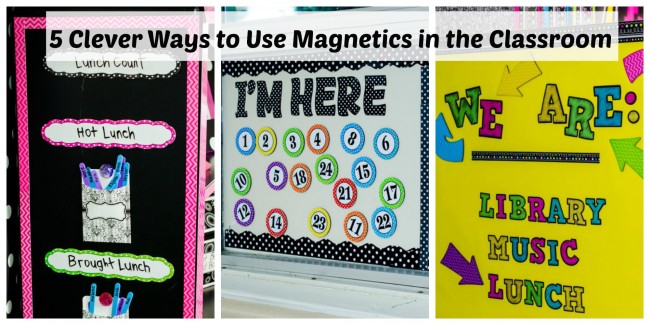
Besides having a supply of white and colored chalk or markers and clean erasers, you might also want to purchase or make board cups. These are simple plastic cups with magnetic strips attached. Place these on the board and keep pens, markers, a pair of scissors, and pencils in them for use if your large group area is near the chalkboard. You can demonstrate art projects, jot down notes, and edit lesson plans from your large group teaching spot by using these materials which are stored on your chalkboard. You may want to make sure the students know that these materials are teacher materials and not to be used by students. You may use strong magnetic tape to keep a clipboard with notepaper attached to the board as well.

You may also have a portable board. This can be used as a versatile divider or a two-sided resource—board for writing on one side, bulletin board on the other. Either way, place this portable board/bulletin board where the students can see it from their seats, but where it does not block the view to the main board or to your desk.

Bulletin Boards
Have bulletin boards available for seasonal projects as well as extra-credit projects and a special section called “Student Choices.” Student Choices will be an area designated for students to post any project or piece of writing of which they are particularly proud. The areas can be divided by children’s last names (for example, an area for A–L) or specific academic groups so that when students place their work on the board, they know which area to use. This ensures that everyone always has a spot to put his or her work, and, with a glance, you can keep track of the posted work.

Special Room Organization Tips
Out and In Bins: Have one area on your desk that is for projects or assignments kids hand in, and another for those papers that have been corrected and need to be handed back. If you teach several subjects, you will need to have an in and out box for each class. You might use stackable metal or plastic baskets. Let the students know about these in and out boxes on the first day of school. The students should be taught to hand their things in when they are completed. You will take that pile at the end of the day, correct the papers, and put them into the out bin by the next morning. As soon as students arrive in class, the first student is allowed to come to the out bin and distribute those papers while the other kids are settling into their seats. Kids love this “duty.” It also saves valuable time collecting or handing out papers during the middle of class.
Mailboxes: You may use one or two cardboard shoe dividers that you can buy in your local department store for your students’ mail. In these mailboxes, place papers to go home, special notes to kids, finished papers, and homework that students miss when they are absent. Label each cube with a child’s name, using laminated colored labels and permanent markers. When you need to reuse the labels the following year, use hair spray on them and the marker ink can be wiped off. Another suggestion is to put a small mailbox on your desk for students to reach you if they need to jot you a note or have a concern or a question.
Coat Hangers: You may want to assign your students coat hangers in alphabetical order by their last names. This will help you at the end of the day by allowing you to take just a glance to determine who left a hat, coat, backpack, etc.
Lunch Tickets: Instead of allowing your students to keep their tickets in their desks where they can easily be lost, create a pocket poster with the names on them for students to store their own tickets in. Place it at a height in your room easily accessible by each student. Be sure it is on a wall that is away from where the students line up so that they don’t have to push through a line to retrieve their lunch tickets.
Pencil Sharpener: Keep this away from all students’ desks and your desk, if possible, so that the sound of grinding won’t disturb those who are working.
Computers: Chances are that you won’t have much choice about where to place computers or tape recorders in your room; you will need to place them where the outlets are and where students won’t trip over the cords. However, give some consideration to the angle at which you place the computers. Will the students working at the computer be able to see the board that you want them to reference? Are the computers located far enough away from individual desks so as not to disturb those working at their desks? The software itself should be well labeled and located near the computers.

Summary
It is essential that you spend time and thought as to how you arrange your classroom. If placed strategically, furniture, materials, resources, student desks, even the writing on the chalk or whiteboard will enhance your teaching by providing an organized and pleasant environment.